News report
Ukraine and Germany Sign 10 Key Agreements During Zelensky Visit
During a visit to Germany on April 14, 2026, President Volodymyr Zelensky signed ten agreements with German officials, significantly boosting bilateral cooperation. These included military contracts and initiatives to revitalize Ukrainian industry.
Share this article
Share to social platforms, or copy the article link and share text manually.
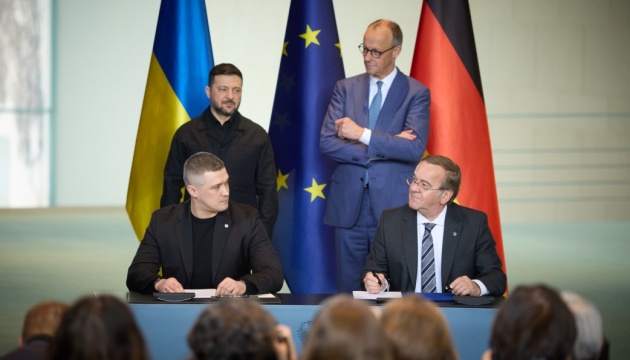
Photo: Ukrinform UA
At a glance
- Ten agreements signed between Ukraine and Germany during Zelensky's visit.
- Defense contracts include PAC-2 missile supply from Raytheon and IRIS-T systems from Diehl Defence.
- Germany to provide an initial €30 million to support Ukrainian industrial recovery.
- Strategic partnership agreement revitalizes high-level government consultations.
- Agreements cover technology collaborations and social policy initiatives.
Why it matters
The agreements strengthen Ukraine's defense and industrial sectors amidst ongoing conflict. This collaboration is crucial for rebuilding Ukraine’s economy and enhancing security against external threats.
https://www.ukrinform.ua/rubric-polytics/4112503-raketi-droni-virobnictvo-zbroi-ta-dopomoga-aki-10-dokumentiv-pidpisali-ukraina-j-nimeccina.html
What Happened
Ukrainian President Volodymyr Zelensky's visit to Germany resulted in the signing of ten agreements aimed at strengthening cooperation between Ukraine and Germany. These agreements were established across various sectors, including defense, industry, and social policy.
Key Details
Among the notable contracts, the Ukrainian Ministry of Defense signed two significant agreements. One contract with the American company Raytheon pertains to the supply of PAC-2 missiles.
The second contract, with German manufacturer Diehl Defence, involves the procurement of IRIS-T systems. Additionally, a Declaration of Strategic Partnership was signed to revitalize intergovernmental consultations, marking a return to such dialogues after 22 years.
This agreement intends to foster regular consultations between the defense and foreign ministers of both countries. Other agreements included a collaboration pact related to the utilization of battlefield data to enhance military technologies.
Another significant agreement outlines Germany's initial contribution of €30 million to support the recovery and resilience of Ukrainian industry. This initiative aims to bolster the role of German manufacturers in Ukraine’s industrial modernization.
Another notable point is the implementation agreement regarding the joint production of unmanned systems Anubis and Seth-X-G, valued at €281 million. There were also memorandums of understanding targeting geological research and social policy support in light of the ongoing conflict with Russia.
Why It Matters
These agreements represent a pivotal step in military and industrial collaboration between Ukraine and Germany at a critical time during Russia's aggression. They are intended to enhance Ukraine's defense capabilities and support its economic recovery, which is vital for the country’s stability.
Background
The signing of these agreements coincides with Ukraine's ongoing efforts to strengthen alliances and augment its defenses against Russian military actions. The revamping of relations with Germany signifies an essential pivot towards international support for Ukraine amidst enduring challenges.
Recent discussions emphasize not only defense but also social and industrial rejuvenation to support the Ukrainian population during these challenging times. Ukraine’s focus on collaboration with Germany comes as part of an overarching strategy to engage with European partners to bolster its resilience and recovery efforts.
These significant agreements underscore a commitment to mutual interests in security, economic resilience, and collaborative governance in the face of external threats.
Source: Ukrinform UA
This report is maintained as a live newsroom article. Headlines and top paragraphs may be tightened when fresh reporting changes the clearest angle.
Newsletter
Get the next major Ukraine report
Follow the strongest verified developments with a cleaner newsroom brief and direct follow-up coverage.
Report format
Fast lead first, then fuller context.
Source photo stays distinct from any illustration.
Related coverage stays inside the same reporting thread.