Breaking news
Russia's Drone Strike Capacity Limited by Launch Sites
An aviation expert stated that Russia's drone strikes on Ukraine are constrained by the number of available launch sites. The remarks were made during an interview on Ukrainian Radio.
Share this article
Share to social platforms, or copy the article link and share text manually.
Developing story
This page is updated as verified details move. The lead and top sections are tightened first when the clearest confirmed angle changes.
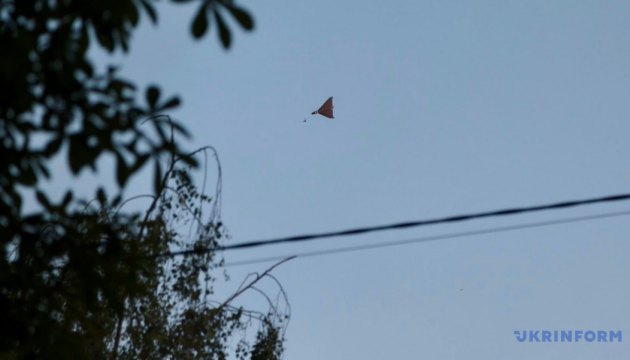
Photo: Ukrinform EN
At a glance
- Russia's drone strikes are limited by available launch sites and munitions.
- Dolintse estimates Russia can produce over 5,000 drones monthly.
- Operational requirements limit the frequency of large-scale drone attacks.
- Preparation for drone strikes requires significant logistical planning.
- The current production capacity is not matched by available warheads.
Why it matters
Russia's limitations in drone deployment could affect their military strategy and operational effectiveness in Ukraine. Understanding these constraints is crucial for anticipating future conflict dynamics.
https://www.ukrinform.net/rubric-ato/4115066-russia-unable-to-sharply-increase-number-of-drones-used-in-its-strikes-on-ukraine-expert.html
What Happened
On April 21, 2026, aviation expert Bohdan Dolintse discussed Russia's drone strike capabilities in an interview with Ukrainian Radio. He highlighted that the primary limitation facing Russia in its use of Shahed drones is not just the availability of munitions but also the insufficient number of launch sites.
According to Dolintse, Russia could produce up to 120 ballistic and cruise missiles per month since 2022. The expert noted that the scale of Russian attacks remains consistent with this production capacity.
He indicated that a typical attack could involve approximately 50 ballistic weapons and 60 to 70 cruise missiles, alongside a smaller number of North Korean missiles. Dolintse elaborated that about two-thirds of this number, roughly more than 3,000 units, comprises Shahed drones.
Despite this high production rate, the time required to prepare for an attack limits operational capabilities.
Key Details
Dolintse emphasized that launching a substantial drone attack necessitates careful planning. To execute an assault involving 700 drones, the military must identify at least 300 to 350 targets.
Each drone requires detailed programming, pre-flight checks, and warhead preparation, adding complexity to the operation. He stated that the frequency of large-scale attacks is likely capped at seven times per month due to these logistical constraints.
Although Russia can manufacture drones at a high volume, it may struggle to produce a corresponding amount of effective warheads under current conditions. Without a modification in the type of munitions used, operational limits will likely be reached.
Additionally, Dolintse pointed out that the number of launch sites is currently the most significant factor restricting the scale of drone deployment. For example, launching 400 drones would require multiple waves from each site, which constrains operational flexibility and effectiveness.
Why It Matters
The constraints on Russia's drone strike capacity suggest that while the country can produce drones in large quantities, operational execution remains hampered by logistics and infrastructure limitations. This could impact the frequency and intensity of future attacks on Ukraine.
Understanding these limitations provides insight into the dynamics of the ongoing conflict and could influence strategic decisions for both Ukraine and Russia moving forward.
Background
The ongoing conflict between Ukraine and Russia has seen a significant increase in drone utilization since 2022. As part of their military strategy, Russia has employed Iranian-made Shahed drones, among other unmanned aerial vehicles, in various attacks against Ukrainian targets.
The strategic implications of drone warfare have been a focal point for both sides, shaping military tactics and resource allocation. Recent developments continue to highlight the evolving nature of aerial combat in the modern battlefield, especially in ongoing war efforts.
Source: Ukrinform EN
This report is maintained as a live newsroom article. Headlines and top paragraphs may be tightened when fresh reporting changes the clearest angle.
Newsletter
Get the next breaking Ukraine update
Receive the fastest lead, key facts, and follow-up links in one concise newsroom note.
Breaking format
The lead carries the core fact first.
Key figures and locations stay near the top.
Related coverage tracks the same reporting line.