News report
German Lawmaker Calls for Ceasefire Before Ukraine-Russia Talks
A German lawmaker emphasized that a ceasefire is necessary for credible peace talks between Ukraine and Russia. This statement was made in an interview with Ukrinform on May 26, 2026.
Share this article
Share to social platforms, or copy the article link and share text manually.
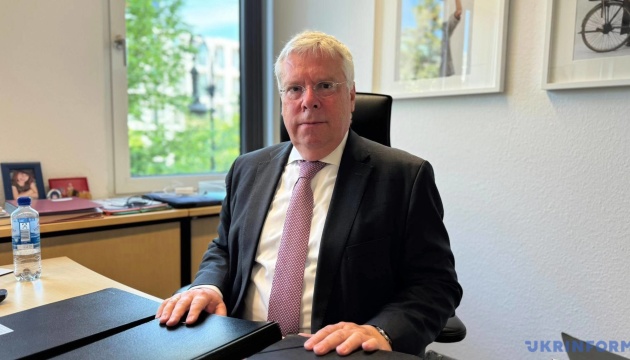
Photo: Ukrinform UA
At a glance
- German lawmaker Jürgen Hardt states a ceasefire is essential for peace talks.
- Putin's refusal to accept a ceasefire is a key factor in stalled negotiations.
- EU and Ukraine have articulated a unified response to Russia's proposals.
- Economic ties with Russia post-conflict depend on major changes in its policies.
- Ukraine's decision-making sovereignty is critical for any peace agreement.
Why it matters
A ceasefire is crucial for establishing equitable peace talks, impacting both regional stability and Ukraine's future security. This necessity reflects ongoing geopolitical complexities and emphasizes international responsibilities in the negotiation process.
https://www.ukrinform.ua/rubric-polytics/4127535-serjoznim-mirnim-peregovoram-mae-pereduvati-pripinenna-vognu-nimeckij-deputat.html
What Happened
In a recent interview with Ukrinform, German Bundestag member Jürgen Hardt asserted that any serious peace negotiations between Ukraine and Russia should be preceded by a ceasefire. He attributed the failure of previous negotiations partly to Russian President Vladimir Putin's refusal to accept this critical condition.
Hardt, who serves as the spokesman for foreign policy issues for the Christian Democratic Union/Christian Social Union (CDU/CSU), stated, "I believe Ukraine must continue to insist that a ceasefire precedes negotiations for peace." He highlighted that without this prerequisite, negotiations cannot be regarded as either credible or equitable.
Key Details
Hardt further elaborated that a just and genuine peace can only be achieved when Ukraine negotiates from a position of strength. He remarked, "If there is a true and just peace, it can only be reached when Ukraine negotiates from a position of strength, and we would, of course, support such a peace agreement if it has Ukraine's backing." He referenced the unified stance adopted by Ukraine and European nations, who have articulated a collective response comprising 20 points against a previously suggested unacceptable 28-point plan from Russia.
On economic relations post-conflict, Hardt indicated that any restoration of economic cooperation with Russia would hinge on fundamental changes in its military policy and overall military rearmament. He mentioned that the European Union could reconsider closer economic ties with Russia if its policies change significantly.
However, he considered such changes plausible only post a genuine peace treaty. Hardt expressed skepticism about a swift transition to peace if Russian military capabilities and presence remain potent near the Ukrainian border, remarking, "If Russia continues to massively rearm and maintains its military presence on Ukrainian land, this is not the basis on which Ukraine could accept peace." He stated that the ultimate decision regarding any peace deal should rest with Kyiv, underscoring the sovereignty of Ukraine in negotiating its future.
Additionally, Hardt suggested that NATO would emerge stronger if Ukraine were to join the alliance, emphasizing that no other army in Europe is as battle-hardened as Ukraine's military. He described the Ukrainian forces as having formed out of a necessity for defensive warfare.
Why It Matters
The insistence on a ceasefire illustrates the ongoing challenges in facilitating genuine negotiations between Ukraine and Russia. It reflects broader geopolitical dynamics and the complexities of securing peace in the region amid continued hostilities. The discussion underscores the international perspective on Ukraine's need for strong security guarantees as a prerequisite for any potential diplomatic resolution.
Background
Negotiations concerning the ongoing conflict have been fraught with difficulties, particularly following Russia's substantial military actions in Ukraine. The U.S. had earlier indicated that negotiations involving Washington had stalled due to a lack of progress, though it remains open to future involvement if conditions allow.
Recent developments have rendered the possibility of cohesive talks even less likely, particularly as Russia has set stringent demands that complicate the negotiation landscape. Hardt's comments come amidst a context of heightened tensions and a push for diplomatic efforts.
The and significant military movement in the region continues to shape the backdrop against which these discussions unfold, complicating the prospects for peace and stability.
Source: Ukrinform UA
This report is maintained as a live newsroom article. Headlines and top paragraphs may be tightened when fresh reporting changes the clearest angle.
Newsletter
Get the next major Ukraine report
Follow the strongest verified developments with a cleaner newsroom brief and direct follow-up coverage.
Report format
Fast lead first, then fuller context.
Source photo stays distinct from any illustration.
Related coverage stays inside the same reporting thread.