News report
Discussion on Russian Propaganda Held in Amsterdam
On June 7, 2026, a public event addressed Russian propaganda's influence at the De Balie cultural center in Amsterdam. Activists and researchers discussed the information war and societal challenges linked to Russia's aggression against Ukraine.
Share this article
Share to social platforms, or copy the article link and share text manually.
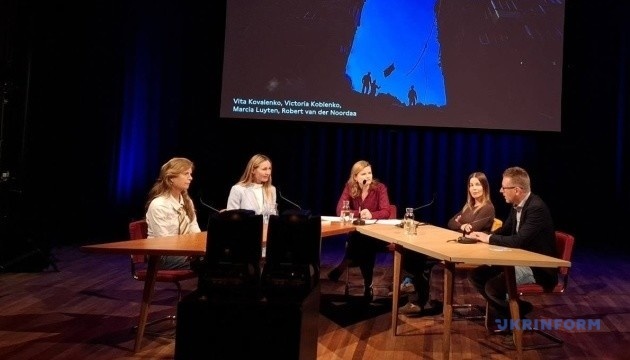
Photo: Ukrinform EN
At a glance
- Public event in Amsterdam addressed Russian propaganda influence.
- Vita Kovalenko emphasized propaganda's role in shaping public sentiment about Ukraine.
- Discussion included the controversial miniseries on Russian-occupied territories.
- Participants criticized misinformation that undermines Ukraine's sovereignty.
- Historical context of Russian propaganda was highlighted by various speakers.
Why it matters
Understanding Russian propaganda's impact is crucial for strengthening democratic resilience in the Netherlands. Effective countermeasures can help maintain public support for Ukraine amid misinformation campaigns.
https://www.ukrinform.net/rubric-society/4131162-amsterdam-hosts-discussion-on-russian-propaganda-influence-in-netherlands.html
What Happened
A public event took place at the De Balie cultural center in Amsterdam, focusing on the impact of Russian propaganda and the challenges faced by democratic nations amid Russia's ongoing aggression against Ukraine. The discussion included perspectives from activists, researchers, and public figures that highlighted key issues surrounding the dissemination of misinformation.
Key Details
The event, reported by a Ukrinform correspondent in The Hague, covered various aspects of the information war, including how social media acts as a vehicle for spreading disinformation. Participants aimed to identify mechanisms for countering false narratives that harm public opinion about Ukraine.
Vita Kovalenko, a Ukrainian activist and city council member from Dordrecht, stated that one of the primary goals of Russian propaganda in the Netherlands is to foster negative attitudes towards Ukraine. Kovalenko's commentary emphasized how such propaganda seeks to diminish public and governmental support for Ukraine by spreading mistruths.
A significant part of the discussion featured the miniseries "Onze man bij de vijand" ("Our Man Among the Enemy"), created by Dutch journalist Thomas Erdbrink and director Roelof van Bokhoven. This controversial project involved illegal visits to Russian-occupied territories, including Mariupol, and has been criticized for promoting narratives that favor Russian viewpoints.
Kovalenko pointed out that this type of media content contributes to the perception that Ukraine should concede territory based on the presence of Russian-speaking residents. She reiterated that this notion does not change the reality of Russia’s unlawful invasion, which violates international law.
Why It Matters
The discussion in Amsterdam underscores the significant role of propaganda in shaping public perception in democratic societies regarding the war in Ukraine. Understanding and countering these narratives remains crucial for maintaining support for Ukraine amid ongoing conflict.
Background
Russian propaganda has been a persistent issue dating back to Soviet times, as noted by Dutch actress Viktoria Koblenko, who described the deep-rooted mechanisms that skew perceptions of Ukraine. She argued that these narratives have been carefully crafted over generations, portraying Ukrainians in a disparaging light.
Koblenko explained that many Russians' support for the ongoing war stems from long-standing myths about Ukraine, perpetuated by a well-established propaganda machine. Meanwhile, Dutch researcher Robert van der Noordaa, who specializes in Russian disinformation, highlighted how effective tactics, including creating informational chaos, hinder public ability to discern truth from falsehoods.
The event also welcomed two members of the Dutch parliament, signaling the importance of addressing the influence and implications of disinformation in public discourse. Kovalenko poignantly remarked, "Wars do not begin with bullets.
They begin with words." This statement encapsulates the essential nature of addressing propaganda in the current geopolitical climate.
Source: Ukrinform EN
This report is maintained as a live newsroom article. Headlines and top paragraphs may be tightened when fresh reporting changes the clearest angle.
Newsletter
Get the next major Ukraine report
Follow the strongest verified developments with a cleaner newsroom brief and direct follow-up coverage.
Report format
Fast lead first, then fuller context.
Source photo stays distinct from any illustration.
Related coverage stays inside the same reporting thread.