Breaking news
Ukraine's UN Envoy Calls Romania Drone Strike a Turning Point
Ukraine's ambassador to the UN, Andriy Melnyk, condemned a drone strike in Romania's Galati during a UN Security Council meeting on June 2, 2026. He asserted this incident illustrates the expansion of Russian aggression beyond Ukraine.
Share this article
Share to social platforms, or copy the article link and share text manually.
Developing story
This page is updated as verified details move. The lead and top sections are tightened first when the clearest confirmed angle changes.
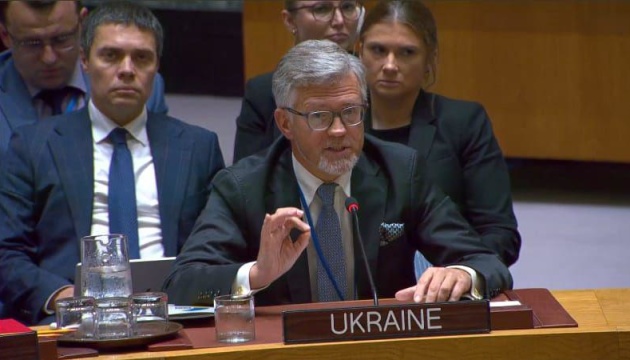
Photo: Ukrinform UA
At a glance
- Ukrainian UN envoy Andriy Melnyk condemned a Russian drone attack in Romania.
- The drone struck a residential area in Galati, injuring civilians.
- Melnyk believes the incident illustrates the expansion of Russian aggression into NATO territories.
- He called for enhanced air defense support for Ukraine from its allies.
- The drone attack holds historical symbolism related to Ukraine's national identity.
Why it matters
The drone strike in Romania signifies a dangerous escalation of Russian hostilities, directly affecting NATO members. It emphasizes the urgent need for strengthened air defenses in Europe to prevent future attacks.
https://www.ukrinform.ua/rubric-polytics/4129528-melnik-nebenzi-prosto-pripinit-brehati.html
What Happened
On June 2, 2026, at an emergency meeting of the UN Security Council, Ukraine's representative Andriy Melnyk addressed the recent Russian drone attack in Galati, Romania. The strike occurred on May 29 when a Russian drone carrying explosives violated Romanian airspace, hitting a residential area and injuring civilians, according to Ukrainian sources.
This incident prompted Romania to call for the urgent Security Council session, where Melnyk expressed solidarity with Romania while dismissing Russian claims of innocence from the attack.
Key Details
Melnyk emphatically rejected statements from Russia's UN representative Vasily Nebenzya, who claimed the Kremlin had no connection to the Galati incident. Instead, he backed Romania's conclusions on the drone's Russian origin.
Melnyk characterized the attack as part of a broader Russian campaign of intimidation against European nations. During his remarks, he referred to previous calls for strikes on European capitals made by Kremlin propagandists such as Vladimir Solovyov and Dmitry Medvedev.
Melnyk stated that the drone attack held dual implications - A direct threat to Romania and other NATO countries to test their resolve against the encroaching Russian conflict. - A symbolic assault on Galati, significant to Ukraine's history as the burial site of Hetman Ivan Mazepa.
He indicated that the attack conveys deep cultural implications for Ukrainians, emphasizing the interconnectedness of history and contemporary conflict. The Ukrainian envoy also highlighted that Russia's war extends beyond territorial disputes, targeting Ukraine's historical narrative and national identity.
He proposed that in order to fortify defenses not only for Romania but also for other European nations against further attacks, there is an urgent need to enhance Ukraine's air defense systems, advocating for a stronger integrated air defense shield with European partners.
Why It Matters
The drone strike in Romania marks a significant escalation in the threat posed by Russian military actions in Eastern Europe. It exemplifies the potential for the conflict to widen and affect NATO member countries directly. The international community's response to such incidents could shape the regional security landscape and influence broader geopolitical dynamics.
Background
This incident follows a series of aggressive moves by Russia that have heightened security concerns for neighboring countries. With the ongoing war in Ukraine, there's been an increasing call for enhanced military support for Ukraine to help counter Russian aggression effectively.
Melnyk called for a collective commitment from international allies to actively intercept and neutralize Russian missiles and drones over Ukrainian territory to curb the threats to all European partners. He cautioned against mere expressions of concern, urging for decisive actions that would eliminate Russia's capability to terrorize not only Ukraine but also its European neighbors.
Throughout his address, Melnyk was firm in refuting allegations directed at Ukraine regarding the Zaporizhzhia Nuclear Power Plant. He urged Russia to relinquish control over the facility swiftly.
In a notable exchange, he quoted a line from a famous Soviet film to underscore the futility of dishonesty in discussions at the Security Council: 'Just stop lying in this hall.' These developments signal a critical moment requiring heightened vigilance and a reevaluation of defense protocols among NATO allies in light of increased aggressions by Russia, emphasizing the importance of historical context in understanding the ongoing conflict.
Source: Ukrinform UA
This report is maintained as a live newsroom article. Headlines and top paragraphs may be tightened when fresh reporting changes the clearest angle.
Newsletter
Get the next breaking Ukraine update
Receive the fastest lead, key facts, and follow-up links in one concise newsroom note.
Breaking format
The lead carries the core fact first.
Key figures and locations stay near the top.
Related coverage tracks the same reporting line.