News report
Kellogg: Putin Must Recognize Russia's Military Failures to End Ukraine War
Kellogg emphasizes the importance of acknowledging military failures for peace talks. This recognition is vital for achieving a ceasefire.
Share this article
Share to social platforms, or copy the article link and share text manually.
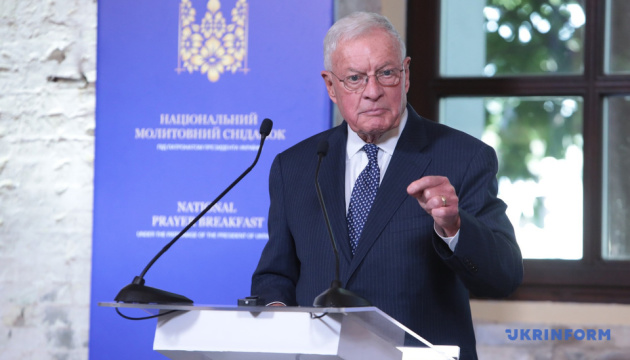
Photo: Ukrinform UA
At a glance
- Putin must recognize Russia's inability to win the war according to Kellogg.
- Russia suffers significant military losses amid ongoing sanctions.
- Kellogg compares Putin's situation to that of Nicholas II, fearing accountability.
- A ceasefire could be possible if both Ukraine and Russia agree to current front lines.
- The United States faces criticism for its diplomatic approach regarding Russia.
Why it matters
Kellogg's statements highlight the critical need for a shift in Russian leadership perspective to facilitate peace negotiations. Acknowledging military inadequacies could lead to a resolution that stabilizes the region and helps mitigate ongoing humanitarian crises in Ukraine.
https://www.ukrinform.ua/rubric-polytics/4100631-putin-mae-usvidomiti-so-rosia-nespromozna-peremogti-u-vijni-kellog.html
What Happened

In an interview with Japan's NHK, former special envoy to Ukraine Keith Kellogg stated that the ongoing war will only end when Vladimir Putin admits that Russia cannot achieve further territorial gains. He emphasized that this acknowledgment is critical for any potential ceasefire.
Kellogg pointed out that international sanctions have severely weakened Russia's military capabilities, resulting in significant losses. Estimates suggest battlefield casualties may range from 1.2 million to 1.4 million, including both deaths and serious injuries.
Key Details
Kellogg noted that both Russian leadership and Putin likely recognize these staggering losses, contributing to their hesitance in initiating peace talks. He expressed concern over Putin's mindset, likening it to that of Tsar Nicholas II, who faced dire consequences after his abdication.
He suggested that Putin fears accountability for the war and indicated that a ceasefire might be possible if both sides agree to halt hostilities along the current front lines.
Background
Kellogg clarified that the continuation of the conflict largely rests on Putin's demands for Ukrainian forces to withdraw from the Donbas region, conflicting with Ukraine's right to retain control over its territories. He criticized the United States for its diplomatic strategy, particularly its recent abstention from a UN resolution aimed at fostering long-term peace in Ukraine.
His remarks reflect growing frustration among the international community regarding Russia's persistent aggression and its impact on regional stability. Kellogg's insights underline the challenges of achieving an end to the conflict, stressing the necessity of a realistic evaluation of military capabilities.
Source: Ukrinform UA
This report is maintained as a live newsroom article. Headlines and top paragraphs may be tightened when fresh reporting changes the clearest angle.
Newsletter
Get the next major Ukraine report
Follow the strongest verified developments with a cleaner newsroom brief and direct follow-up coverage.
Report format
Fast lead first, then fuller context.
Source photo stays distinct from any illustration.
Related coverage stays inside the same reporting thread.