News report
Kremlin Changes Propaganda Strategy to Address Demographic Crisis
This strategy change responds to declining birth rates and military losses in Ukraine. The Kremlin aims to encourage childbirth through various media campaigns.
Share this article
Share to social platforms, or copy the article link and share text manually.
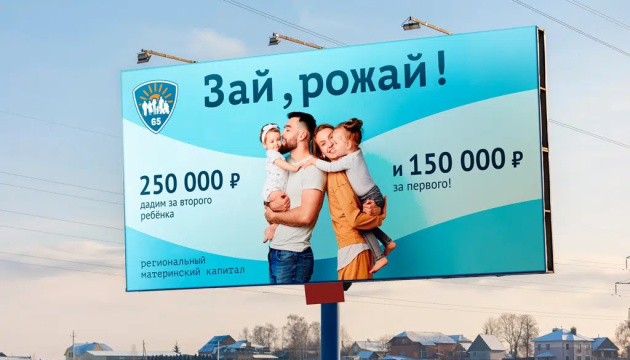
Photo: Ukrinform UA
At a glance
- Kremlin pivots from wartime rhetoric to reproductive encouragement.
- Russia's birth rate has fallen to 1.37 children per woman, below the replacement level.
- Media coverage of large families has surged sevenfold since the war began.
- Financial incentives for teenage pregnancies are being introduced.
- The state's rhetoric equates unborn children with future military personnel.
Why it matters
This shift in propaganda reflects the Kremlin's urgent response to declining birth rates amidst significant military losses in Ukraine. Understanding this change offers insight into Russia's social policy direction and its implications for the future demographic landscape.
https://www.ukrinform.ua/rubric-world/4101876-propaganda-kremla-perejsla-z-voennoi-ritoriki-na-reproduktivnu-rozvidka.html
Kremlin's New Approach

The Kremlin has altered its propaganda strategy, moving from a focus on wartime rhetoric to promoting reproductive policies. This shift comes amid a critical demographic crisis worsened by significant military losses in the ongoing war against Ukraine.
Reports from Ukraine's Foreign Intelligence Service note that Russia's birth rate has dropped to concerning levels, with the latest figure at 1.37 births per woman, significantly below the 2.1 needed for population stability.
Increase in Childbirth Promotion
In response to this demographic challenge, Russian media coverage concerning childbirth and large families has surged sevenfold since the beginning of full-scale hostilities. Advertisements in urban areas are actively encouraging higher birth rates, targeting younger audiences with provocative messaging.
Calls for teenage pregnancies include financial incentives for schoolgirls, offering between 100,000 to 150,000 rubles. Campaigns like the one at a Nizhny Novgorod university, featuring the slogan 'Engage, Reproduce!', are part of a larger effort to bolster birth rates across regions.
State Organizations and Messaging
The Kremlin has also established organizations such as 'Women for Life' to monitor medical practitioners and promote anti-abortion sentiments. Their campaigns link unborn children to potential future soldiers, urging citizens with messages like 'Protect me today, and I will defend you tomorrow.' This cultural shift occurs as Russia faces the consequences of heavy military casualties, with estimates of over 1.2 million personnel lost since the invasion's start.
Political Implications
This dramatic shift in propaganda highlights the Kremlin's urgent response to declining birth rates amid significant military losses. It offers insights into Russia's evolving social policy and its potential implications for future demographics.
Political figures, including State Duma member Alexander Ilytkov, express an increasingly instrumental view of women’s reproductive roles in supporting military needs. The sentiment, 'As long as the birthing machine works, do what your given role commands,' reflects the regime's focus on population growth to reinforce military capacity.
This messaging represents a broader agenda to regain demographic control in light of a challenging military situation and waning public morale.
Source: Ukrinform UA
This report is maintained as a live newsroom article. Headlines and top paragraphs may be tightened when fresh reporting changes the clearest angle.
Newsletter
Get the next major Ukraine report
Follow the strongest verified developments with a cleaner newsroom brief and direct follow-up coverage.
Report format
Fast lead first, then fuller context.
Source photo stays distinct from any illustration.
Related coverage stays inside the same reporting thread.