News report
German Chancellor: EU Loan to Ukraine Should Not Reduce Bilateral Aid
German Chancellor Friedrich Merz stated that a €90 billion EU loan to Ukraine should not result in cuts to bilateral assistance. He made these remarks during a press briefing after the European Council meeting in Cyprus.
Share this article
Share to social platforms, or copy the article link and share text manually.
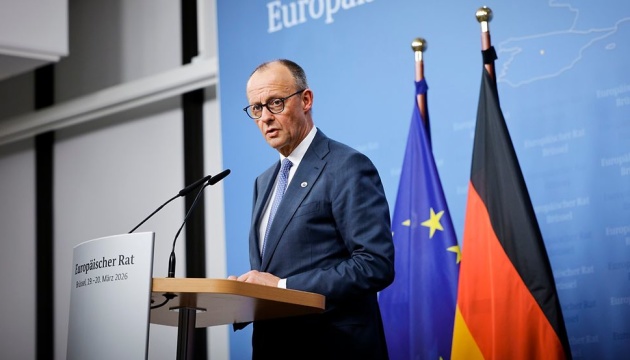
Photo: Ukrinform UA
At a glance
- Chancellor Merz insists EU loan should not reduce bilateral support.
- Loan of €90 billion will complement existing support frameworks.
- Merz emphasizes need for ongoing cooperation between Ukraine and EU states.
- He acknowledges the unblocking of financial aid from Hungary.
- The EU's 20th sanctions package against Russia was also discussed.
Why it matters
The commitment to uphold bilateral support for Ukraine amid EU financial measures is essential for Ukraine's ongoing stability and security. Merz's statements reassure continued aid as the country confronts significant challenges.
https://www.ukrinform.ua/rubric-polytics/4116336-merc-kredit-es-dla-ukraini-ne-mae-prizvesti-do-skorocenna-dvostoronnoi-dopomogi.html
What Happened
Friedrich Merz, the Chancellor of Germany, addressed concerns regarding a €90 billion loan from the European Union aimed at supporting Ukraine. During a press conference following an European Council meeting in Cyprus, Merz asserted that this financial assistance must not serve as a justification for reducing bilateral support from individual EU member states to Ukraine.
Key Details
Merz emphasized that the newly approved loan should complement rather than replace existing bilateral agreements. He said, "No, this [the provision of the loan] categorically does not mean cuts.
I called on my colleagues yesterday: please do not use this loan as a reason to cut back or fully abandon bilateral agreements with Ukraine." He stressed the importance of maintaining both collective EU efforts and direct cooperation between Ukraine and individual member states. Merz expressed his ongoing commitment to foster bilateral relations with Ukraine, irrespective of the EU loan.
Following the meeting, Merz acknowledged the recent unblocking of financial aid from Hungary and the commencement of the loan disbursements, initially agreed upon in December of the previous year. Earlier discussions with Ukrainian President Volodymyr Zelensky highlighted the urgent situation within Ukraine and underscored the ongoing commitment of Germany to support Ukraine during these challenging times.
He welcomed the adoption of the 20th sanctions package against Russia by the EU, referring to it as a clear signal to Moscow that Europe will not retreat in its stance. "On the contrary, we will continue to escalate pressure," he declared.
Why It Matters
The reinforcement of bilateral support is crucial for Ukraine, particularly amid its ongoing conflict with Russia. Merz's comments aim to ensure that the framework of support remains robust, allowing for multiple avenues of assistance without diminishing direct aid.
Background
The €90 billion EU loan marks a significant financial commitment by the European Union to support Ukraine, particularly as the country continues to face challenges pertaining to its sovereignty and territorial integrity. The aid package and the associated sanctions against Russia are part of a broader strategy by European nations to respond firmly to the geopolitical tensions in the region.
Germany's role and leadership in facilitating this support highlight its pivotal position within the EU and its commitment to Ukrainian sovereignty.
Source: Ukrinform UA
This report is maintained as a live newsroom article. Headlines and top paragraphs may be tightened when fresh reporting changes the clearest angle.
Newsletter
Get the next major Ukraine report
Follow the strongest verified developments with a cleaner newsroom brief and direct follow-up coverage.
Report format
Fast lead first, then fuller context.
Source photo stays distinct from any illustration.
Related coverage stays inside the same reporting thread.