News report
Expert Discusses Putin's Distortion of History in Ukraine Conflict
Niels Drost, a researcher at the Clingendael Institute in the Netherlands, states that Vladimir Putin exploits a selective version of history to rationalize the war against Ukraine. This insight was shared during comments made to Ukrinform in The Hague.
Share this article
Share to social platforms, or copy the article link and share text manually.
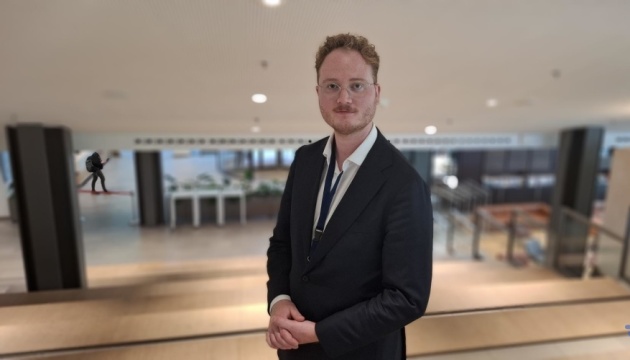
Photo: Ukrinform EN
At a glance
- Putin uses a selective historical narrative to justify aggression.
- He frames Ukrainians as 'Little Russians' to undermine their sovereignty.
- Understanding these tactics is crucial for effective counteractions.
- Historical distortion influences Western perceptions of the conflict.
- Drost emphasizes the importance of educating the public on Ukraine's history.
Why it matters
Drost's insights reveal how historical distortion can manipulate public perception to legitimize conflict. Addressing these narratives is crucial for supporting Ukraine's sovereignty and countering propaganda efforts by Russia.
https://www.ukrinform.net/rubric-polytics/4129177-expert-putin-is-using-his-own-version-of-history-as-weapon-to-justify-war-against-ukraine.html
What Happened
Niels Drost, a research fellow at the Security Division and the Center for Research on Russia and Eastern Europe (CREEC), expressed concerns about Vladimir Putin's manipulation of historical narratives to support his aggression against Ukraine. Drost spoke to Ukrinform while participating in a two-day Security Conference in The Hague, emphasizing the need to recognize Putin’s strategic use of history.
Key Details
Drost explained that Putin's rhetoric frames Ukrainians as 'Little Russians,' suggesting a historical unity between Russians and Ukrainians over a millennia. This narrative serves to diminish Ukraine's status as a sovereign state.
He pointed out that understanding this historical distortion is crucial for the international community, especially those in the West who may not be familiar with Ukraine’s actual history. Drost noted that during an interview with Tucker Carlson, Putin presented his historical interpretation convincingly, which could mislead audiences unfamiliar with details surrounding Ukraine's history.
Furthermore, Drost highlighted that Putin’s manipulation of historical narratives is not merely for domestic consumption but aimed at shaping perceptions among Western audiences, thereby justifying Russia's military actions. He cautioned that failing to comprehend this tactic limits effective counteractions against Russia's propaganda.
Why It Matters
The use of historical narratives is pivotal in shaping public opinion and justifying military aggression. Understanding Putin’s tactics is essential for formulating responses to Russian aggression and requires a thorough grasp of historical contexts that many in the West may lack. Recognizing these methods can help counteract misinformation and support Ukraine’s sovereignty.
Background
Drost explained that Putin has gradually escalated his rhetoric regarding Ukraine over the years. Initially emphasizing closeness, he transitioned to asserting that Ukrainians and Russians are essentially one people.
This shift became particularly pronounced following the annexation of Crimea. The expert warned that appeasing narratives can create dangerous misconceptions within Europe. Drost also addressed the broader challenges posed by hybrid warfare, which includes propaganda and influence operations alongside military aggression.
He urged European nations to take these threats seriously and not underestimate Putin’s intent. The Security Conference in The Hague featured discussions and lectures aimed at engaging younger generations on issues of European and global security.
Dutch Prime Minister Rob Jetten, who participated in the conference, affirmed his support for Ukraine’s EU membership aspirations and the urgency of beginning negotiations.
Source: Ukrinform EN
This report is maintained as a live newsroom article. Headlines and top paragraphs may be tightened when fresh reporting changes the clearest angle.
Newsletter
Get the next major Ukraine report
Follow the strongest verified developments with a cleaner newsroom brief and direct follow-up coverage.
Report format
Fast lead first, then fuller context.
Source photo stays distinct from any illustration.
Related coverage stays inside the same reporting thread.